Leonhard Euler
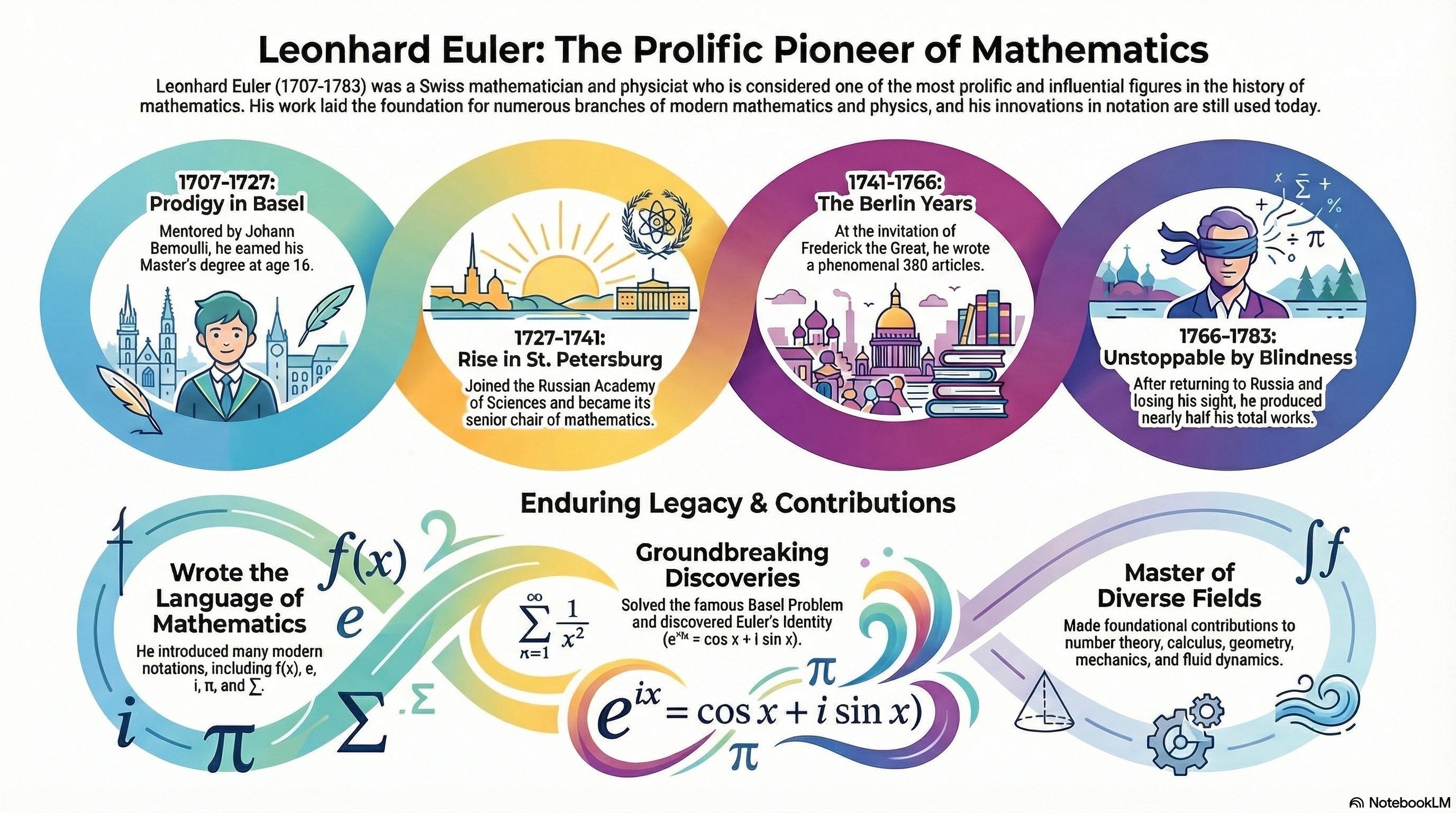
The life of Leonhard Euler - The Master of Us All.
Euler’s Identity
Published in the 1740s, this formula became iconic for uniting analysis, geometry, and arithmetic at a time when complex numbers were still controversial.
Euler’s Formula (Complex Exponentials)
Euler introduced this in the mid-18th century, giving complex numbers a geometric interpretation that transformed trigonometry and analysis.
Euler’s Polyhedron Formula
Discovered in 1752, this relation marked one of the earliest results in topology, long before the field had a name.
Basel Problem Solution
Euler solved this famous problem in 1734, astonishing contemporaries by linking infinite series to \(\pi\).
Euler–Lagrange Equation (Euler’s Original Form)
Euler developed this equation in the 1740s while founding the calculus of variations, later refined with Lagrange.
Euler’s Totient Formula
Introduced in the 1760s, this identity emerged from Euler’s systematic generalization of Fermat’s number-theoretic ideas.
Euler’s Product Formula for the Zeta Function
Euler discovered this in 1737, revealing for the first time a deep analytic link between prime numbers and infinite series.
Euler’s Identity for Homogeneous Functions
Formulated in the 1750s, this result arose from Euler’s broader effort to formalize scaling laws in mechanics and geometry.
Sources: https://mathshistory.st-andrews.ac.uk/Biographies/Euler/