Johann Carl Friedrich Gauss
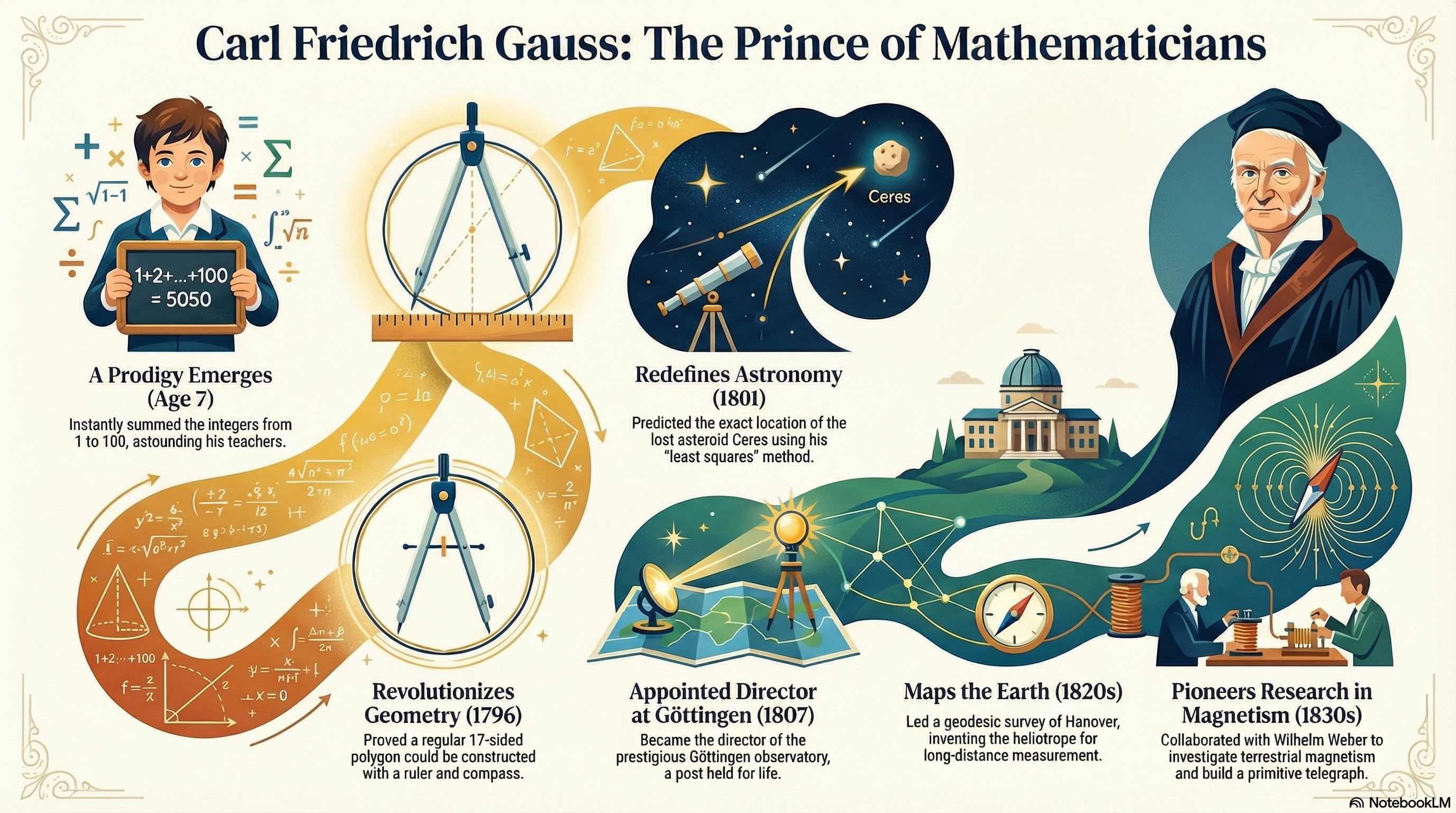
The life of Johann Carl Friedrich Gauss - The Prince of Mathematics
Fundamental Theorem of Algebra
Gauss gave the first rigorous proof in 1799, helping legitimize complex numbers within mainstream mathematics.
\[ p(z) = 0 \quad \text{has at least one complex root} \]
Gaussian Integral
This result appeared in Gauss’s early 19th-century work on probability and error theory tied to astronomical observations.
\[ \int_{-\infty}^{\infty} e^{-x^2} \, dx = \sqrt{\pi} \]
Gauss’s Law (Electrostatics)
Developed in the 1830s, this law became foundational to electromagnetism decades before Maxwell unified the field.
\[ \oint_{\partial V} \mathbf{E}\cdot d\mathbf{A} = \frac{Q_{\text{enc}}}{\varepsilon_0} \]
Quadratic Reciprocity Law
Gauss proved this in 1801 and famously called it the “golden theorem” of number theory.
\[ \left(\frac{p}{q}\right)\left(\frac{q}{p}\right) = (-1)^{\frac{(p-1)(q-1)}{4}} \]
Sources: https://mathshistory.st-andrews.ac.uk/Biographies/Gauss/